Research Projects
Questions such as these are the primary focus of the Applied Park Science Lab and its team. Our program of research, education, and training is designed to provide graduate students a comprehensive toolbox to effectively address the myriad of issues concerning parks and protected area management and increasing public understanding of the natural, cultural and recreational value of these resources.
Current Projects
United States Forest Service Project:Our research examines how climate change, wildfires, drought, and social factors drive recreation displacement in Southern California’s national forests. By integrating fire-risk modeling, mobile device data, and surveys, we aim to understand visitation dynamics, identify vulnerable sites, and explore how experiential and environmental attributes influence recreation choices. This work informs strategies for access and sustainable management to help forest managers maintain quality experiences while protecting natural resources. |
2027-2037 Kansas Statewide Comprehensive Outdoor Recreation Plan (SCORP):This project sets out a shared vision for the future of outdoor recreation in Kansas. It brings together research, community input, and long-term planning to help guide how outdoor spaces are developed, maintained, and used across the state. The plan supports collaboration among public agencies, organizations, and communities. More importantly, it serves as a practical guide for understanding current needs and planning for the future. Overall, the SCORP helps ensure that outdoor spaces across Kansas remain welcoming and valuable for people today and for generations to come. |
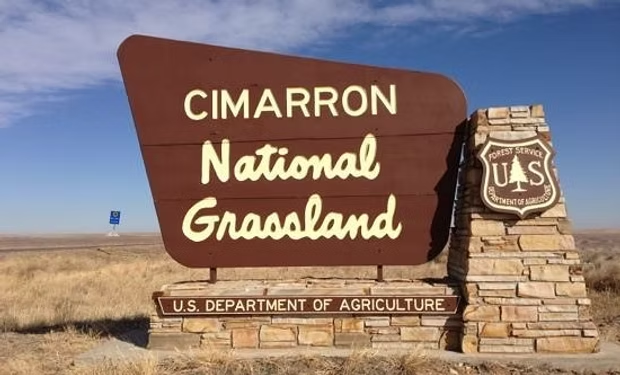
Cimarron National Grassland: |
Konza Prairie Biological Station:This study explored whether educational signage can enhance visitor awareness of natural soundscapes and improve perceived restoration in a tallgrass prairie setting. Conducted at Konza Prairie, the research tested sign treatments designed to reduce human-caused noise and measure outcomes using acoustic monitoring and visitor surveys. While signs significantly lowered noise levels on the trail, they did not lead to measurable improvements in visitor awareness or well-being. Findings suggest that while signage can benefit wildlife by reducing noise, additional strategies, such as educational outreach may be needed to help visitors engage with natural sounds and experience their restorative benefits. |
Saguaro National Park:This project investigates how Leave No Trace (LNT) Soundscape Guidelines can reduce human-caused noise in national parks and improve visitor well-being. By testing messaging strategies, researchers measured changes in the physical soundscape using acoustic monitoring, assessed visitor perceptions through surveys, and explored whether focusing on natural sounds enhances cognitive restoration and health benefits. The study also included participatory mapping to identify areas where visitors considered noise acceptable or unacceptable, providing managers with practical tools to protect natural soundscapes while promoting positive visitor experiences. |
Yellowstone National Park:This research examined how Leave No Trace (LNT) training is delivered, experienced, and understood by concessionaire managers and seasonal employees in Yellowstone National Park. Using a qualitative approach, the study explored perceived barriers to providing LNT training, as well as how seasonal employees experienced the training and applied it to their recreation behaviors. By focusing on individuals working in protected natural environments, the research highlighted the role of LNT education in fostering deeper connections to nature and promoting pro-environmental behavior. Overall, the study provided insight into how concessionaire seasonal employees could meaningfully support the National Park Service’s mission to protect natural and cultural resources through responsible recreation. |